Massad Poulos, Senior Adviser to U.S. President Donald Trump for Arab and African Affairs said that the U.S. is « optimistic » about the potential to reach a final agreement for the Sahara conflict.
Poulos told Sky News Arabia during an interview that Washington views Morocco’s self-rule plan as a credible basis for a « durable and peaceful resolution » under Moroccan sovereignty.
The interview drew considerable criticism from media sources linked to the Polisario Front and Algeria which alleged U.S. bias toward Morocco. Unverified posts across social media alleging protests in Laayoune against the autonomy plan were also reported, but none could be independently verified.
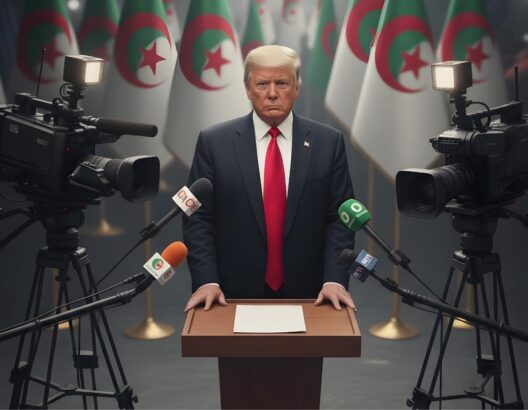
Simultaneously, discourse in selected Algerian media outlets and throughout social networks ramped up, with articles and statements denouncing the U.S. president’s behavior. Some accused him for not appreciating Algeria’s political and cultural context, while others went so far as to label him “irresponsible,” “Nazi,” or “liar”—language that, observers noted, crossed red lines from both the Sahrawi and Algerian standpoints.
In that sense, the Algerian newspaper « Echorouk » published an article written by a writer judged for his separatist leanings and linkages to the Polisario Front alleging that Morocco fooled a former US president, Donald Trump and several other countries by depicting itself as a “paradise for investments and major projects.”
The writer also claimed that Trump lied when he announced the opening of a US consulate in the city of Dakhla, reasoning that his well-known tweet at the very end of his presidency in 2020, in which he stated that the US recognizes Morocco “sovereignty over its Sahara,” was only political propaganda and empty rhetoric about a diplomatic achievement.
This story is part of a new Algerian media campaign to denounce the Trump administration’s acknowledgement of Morocco’s sovereignty over Western Sahara and to question Washington’s authenticity in relation to the matter, especially in light of continued discussions regarding the implementation of the agreements made at that time.
The Algerian publication « El Ikhbariya » penned a story disparaging previous U.S. President Donald Trump for “betraying the principle of self-determination,” and attempting to “impose an unjust solution on the Sahrawi people.” It went as far as to assert that the States “treated the United Nations as though it was an American foreign ministry,” and even escalated to insinuating that Trump was comparable to “Nazism.”
Nevertheless, these claims “are not substantiated by credible evidence or actual facts.” The Trump-decree signed in December of 2020 was “not an inversion of the principle of self-determination,” but “a political declaration recognizing Morocco’s sovereignty over the Sahara.” The decision did not rescind, or restrict Washington from supporting peaceful solutions, nor did it “diminish the role of the United Nations” in supervising the ongoing negotiation process.
By contrast, a man named Bonif, who presents himself as an Algerian journalist, made inaccurate and unreliable statements marked by personal attacks and accusations against Morocco and its institutions. He claimed that U.S. President Donald Trump does not understand the nature of the Algerian-Moroccan dispute, insisting that the conflict “has nothing to do with the Sahara,” and even asserted that “the Polisario Front is stronger than Trump’s decisions.”
However, this rhetoric contradicts his own previous recordings, in which he expressed hardline views describing the Sahara as a “colony” and promoting the Polisario’s narrative through misleading claims aimed at separating the Sahara from Morocco. This change in tone suggests that recent developments in the issue have caused evident confusion within the anti-Moroccan media discourse.
The article that appeared in « Algeria Today » presents Algeria’s position, as « a voice of conscience against power, » opposed to what is suggested are the « American deals. » This is pure propaganda, and a gross simplification of the diplomatic and legal realities. The issue has long been situated within a clear United Nations framework, and different political positions do not give anyone the right to monopolize concepts of justice or history.
The attention and reciprocal reactions highlight that the Sahara issue is as much a « contention of narratives » as it is a political issue. While Washington continues to assert its support for a path based on « autonomy under Moroccan sovereignty » accelerated by further « UN monitoring », Algerian media outlets continue to dispute this position and label it as biased. In this charged context, it will be increasingly necessary to « differentiate between opinion and propaganda », on the one hand, and « evidence-based information » on the other—while respecting « UN resolutions » and the negotiation process instead of internalizing slogans and personal attacks.